
勇者义彦与魔王城
China takes 97% of H1 global humanoid robot shipments; supply chains, vast market drive rapid scale-up, intl reach: expert_我的网站

A |
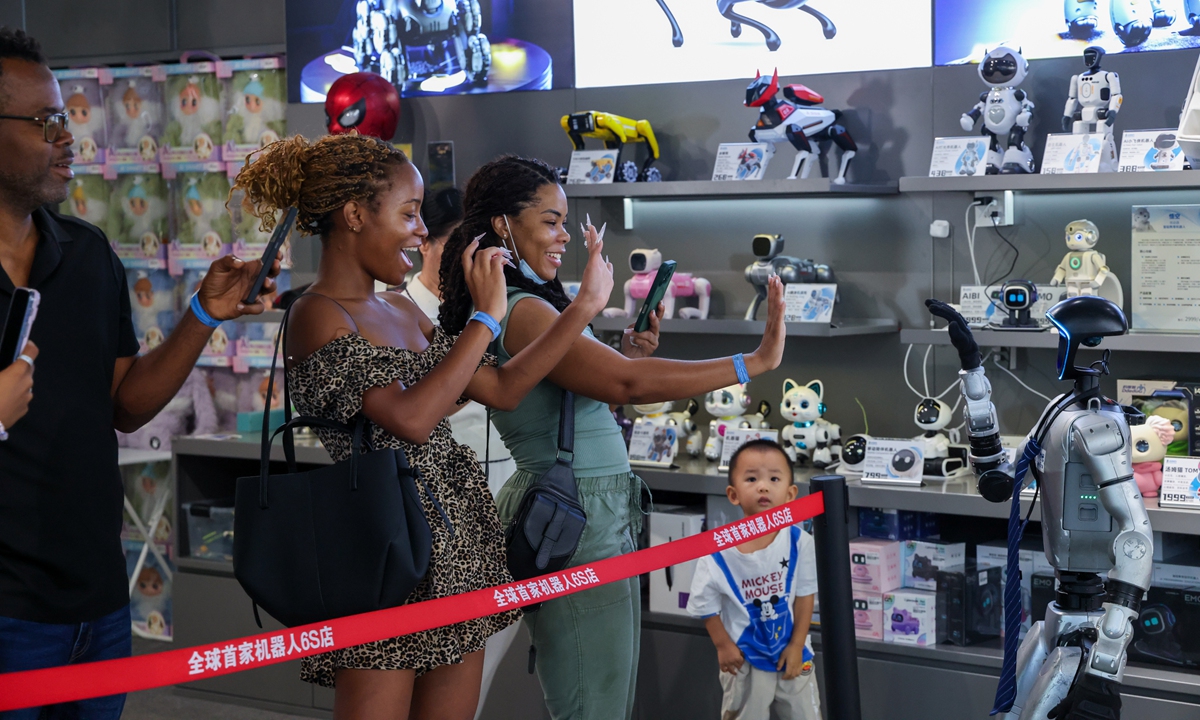
Industry data showed that Chinese vendors accounted for more than 97 percent of global humanoid robot shipments in the first half of 2026. Additionally, Chinese robotics firm Unitree Robotics began its share subscription process for its listing on Shanghai's stock market, becoming the first humanoid robot A-share stock.
The global humanoid robot shipments reached approximately 19,100 units in the first half of the year, surging 272 percent year-on-year. The market saw a leadership shift, with Chinese robotic company AGIBOT overtaking Unitree to become the world's largest humanoid robot vendor. China also represented more than 85 percent of global demand, according to the latest research from Smart Analytics Global (SAG).
As the former global leader in 2025 with annual shipments of 5,500 units, Unitree Robotics set its IPO offering price at 150.8 yuan ($22.35) per share on Monday. The initial public offering (IPO) is expected to raise 6.1 billion yuan, meaning an estimated market capitalization of around 61 billion yuan, according to media reports. The final online subscription winning rate will be 0.0181 percent, Unitree said on Monday.
The breakthroughs in humanoid robotics represent the latest landmark of China's booming "new new three" industries, which are emerging as core pillars driving the country's high-end manufacturing upgrade, export expansion and future economic growth.
Driving forces
The rapid and comprehensive rise of China's robotic sector stems not merely from policy incentives, but from integrated advantages in complete manufacturing chains, forward-looking institutional arrangements and massive real-world application scenarios, industry analysts noted.
"The answer lies not in mere policy slogans, but in the synergies rooted in its manufacturing base, early institutional frameworks, and vast application scenarios. These factors have driven the 'new new three' industries onto the global stage," Zhang Xiaorong, director of the Beijing-based Cutting-Edge Technology Research Institute, told the Global Times on Monday.
A robust supply chain has been decisive. The localization rates across China's robot industry chain have risen markedly in 2026, with core components shifting to domestic control, CCTV News reported, citing an executive of a Shenzhen-based robot company, who said that more than 90 percent of key parts for its humanoid robots are sourced domestically.
"No other market is better suited for the robotic industry than China," the executive said.
Institutional analysis noted that the domestic production rate of Unitree Robotics' supply chain reaches 90 percent, while all core components are fully self-developed.
Zhang also said the large domestic market serves as a unique testing ground.
"Strong robot exports reflect advances in complete machine design, system integration, scenario algorithms, rapid delivery, and cost control, alongside continued localization of reducers, servo systems, and sensors. Large-scale applications in new energy vehicles, electronics manufacturing, and warehousing provide frequent iteration and engineering validation," said Zhang.
Institutional foresight also played a role. Robot manufacturing was first listed as an independent industry in the national standard for industry classification in October 2017, with sub-categories including "industrial robot manufacturing" and "special operation robot manufacturing" following in 2023.
Analysts noted that this early classification facilitated later policy support, capital-market positioning, and statistical monitoring.
In June 2026, several ministries launched a special program for real-scenario training of humanoid robots and embodied AI.
Customs adjustments, effective from January 1, added specific tariff codes for intelligent biomimetic and cleaning robots, simplifying export clearance.
Insurance coverage also followed. In June, China Export & Credit Insurance Corp issued an insurance policy for AGIBOT's embodied robot export project, providing overseas risk coverage.
Supported by complete industrial chains, rich scenarios and systematic policy guarantees, China's robotic sector has built an unshakable global edge, experts noted.
A faster pace
Official data showed that China has more than 400 complete humanoid robot models - over half the global total - while quadruped robots account for nearly 70 percent of worldwide sales.
"China may produce more than 100,000 humanoid robots this year, with even higher growth expected in the following years, pointing to long-term opportunities in a sector with deep potential," Yang Delong, chief economist at Shenzhen-based First Seafront Fund, told the Global Times on Monday.
China's robot export momentum has also reached new heights. After becoming a net exporter of industrial robots for the first time in 2025, China's industrial robot exports reached 6.29 billion yuan in the first half of 2026, reaching 141 countries and regions, official statistics show. Surgical robot exports rose 3.3 times year-on-year. Overall robot exports grew 359 percent.
AGIBOT, the champion of humanoid robot shipment so far this year, illustrated the rapid scaling: Its 15,000th embodied AI robot rolled off the line on June 28, less than three months after the 10,000-unit milestone.
All units are being delivered to domestic and overseas customers for use in 3C (computer, communication and consumer electronics) manufacturing, warehousing and logistics, and commercial services, AGIBOT told the Global Times.
Jiang Qingsong, company partner and co-president of AGIBOT, told the Global Times on Monday that the company aims for overseas sales to exceed 30 percent of its total in 2026 and potentially surpass 50 percent later.
Strong progress in robotics is closely backed by China's booming artificial intelligence sector.
Hugging Face's latest report found that over the past year, "Chinese models quickly accounted for the plurality or 41 percent of downloads," surpassing the US for the first time.
On the OpenRouter platform, Chinese AI models' token usage reached 34.25 trillion in the week ended Sunday, meaning roughly half of global share, while remaining ahead of US models for the 15th consecutive week.
Yang noted that China's AI progress is supporting growth across six frontier sectors - robotics, semiconductors, computing power and algorithms, commercial spaceflight, solid-state batteries, and biomedicine.
In terms of innovative drugs, by the end of 2025, China had 4,751 innovative drugs in development - 33.7 percent of the world total - making it the global leader in the pipeline.
Outbound licensing deals totaled about $110 billion in the first half of 2026 - already 80 percent of the full-year 2025 figure - with Chinese firms occupying eight of the global top 10 pharma deals. During the same period, 38 innovative drugs were approved, according to data from National Medical Products Administration.
Benefit the world
The vigorous rise of the "new new three" industries marks China's third major upgrade in export structure, following the traditional "old three" (garments, furniture and home appliances) and the "new three" (new energy vehicles, lithium-ion batteries and photovoltaics). Each industrial iteration features higher technological content, stronger innovation capacity and deeper integration into the global economy.
China's breakthroughs in robotics, AI and innovative medicine deliver tangible benefits to global industries and consumers.
For example, AGIBOT's European representative Sandy Liu told the Global Times that universities and large manufacturers in automotive and warehousing are the company's main users in Europe, driven by rising labor costs and the need for new solutions.
Chinese open-source AI models have transformed high-end artificial intelligence technology from exclusive luxury resources into affordable, accessible digital infrastructure, benefiting global startups and developing economies. Innovative drug outbound licensing also accelerates global research collaboration and improves global patient access to cutting-edge treatments, analysts pointed out.
China's role in global trade is shifting from single manufacturing links toward a deeper embedding in technology, systems, and standards. What remains constant is the innovation that injects valuable certainty into the world economy and supports more inclusive globalization, analysts noted.
。

B | 据1月10日《每日经济新闻》报道,腾讯互动娱乐与“英雄联盟”开发商first game宣布成立合资公司“腾锦体育”,将组建一支专门的电子体育团队。据报道,腾讯集团高级副总裁马晓毅是董事会主席,腾讯互动娱乐英雄联盟(Tencent Mutual Entertainment Heroes Alliance)有限责任合伙公司(LPL)总裁金一波是中国区业务主管,首屈一指的李连松(Leo Lin Song)是联合首席执行官。腾津体育不仅负责围绕中国英雄联赛核心赛事管理和整体运作,还负责国际拳赛和商务代理商的本地化和推广。成立腾锦体育,就是要使英雄联盟独立于中国企业,建立以市场为导向的主公司,进一步整合竞争资源,开放产业链上下游,扩大业务多元化和可持续发展。防暴游戏,美国在线游戏开发商,成立于2006年,是英雄联盟的代表作。2008年,腾讯成为主要股东。2011年2月,腾讯花费大量资金收购了90%以上的股份。2015年12月17日,防暴游戏在其官方网站上宣布,其主要股东腾讯已收购了公司的剩余股份,这意味着腾讯已实现对公司的100%控制。
Current article:http://a5z.cuntoujuefourantapai.cfd/nbw/kizmj.html
Published on:03:18:11
 央行8月14日将开展10000亿元买断式逆回购操作
 韩先楚回老家见公社干部几十人,直接给毛主席写信:必须精简,历史看兴衰,原创 韩先楚回老家见公社干部几十人,直接给毛主席写信:必须精简
 全市欧美同学会工作交流活动举行 为浙西片区创新创业共谋良策
 全新别克GL8陆上公务舱上市 22.99万 双层声学玻璃/二排贵宾座椅
 公安机关公布4起编造传播涉台风等网络谣言典型案例
 香港女星可人Kelly疑似被假富豪骗 本人发文撇清关系