钢铁侠3
书名:世界第一等|作者:笑无语|本书类别:古言|更新时间:06:37:27|字数:3896字
一 |
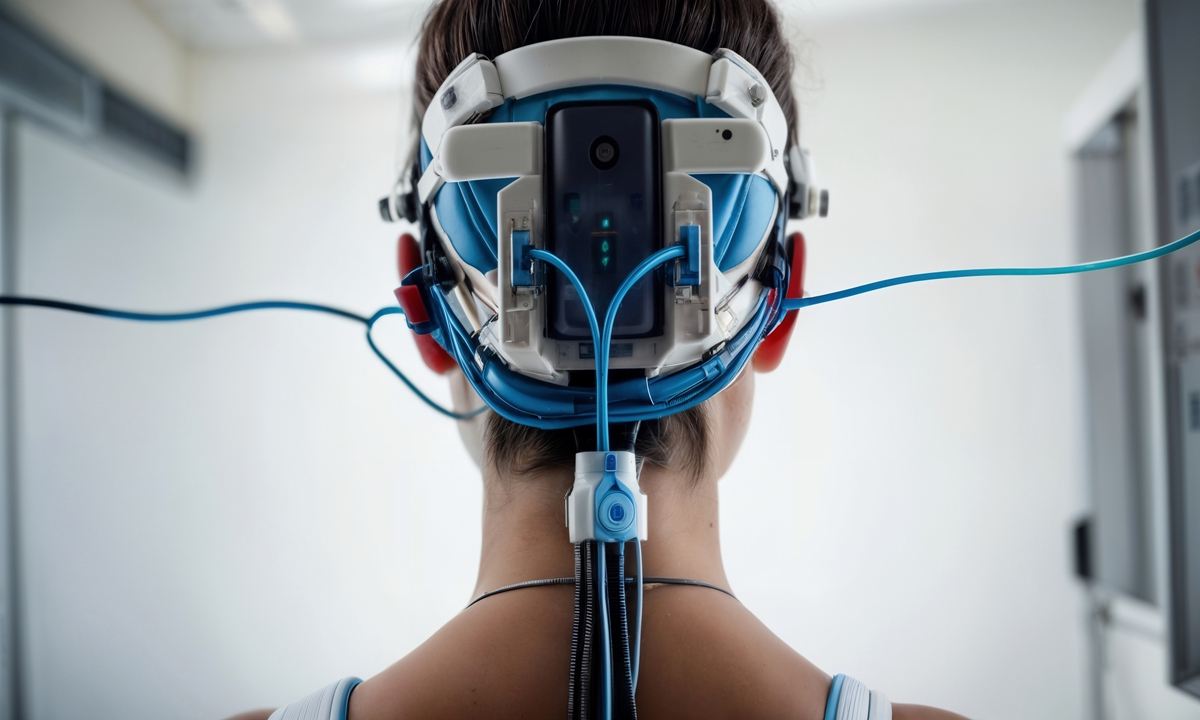
Chinese researchers have developed a multifunctional electrode coating that addresses key challenges in long-term brain-computer interface (BCI) implantation, including signal loss and tissue adhesion, bringing BCI one step closer to clinical application, the Global Times learned from the research team behind the findings on Sunday.
As an emerging field combining neuroscience and artificial intelligence (AI), BCI faces a major challenge of ensuring long-term compatibility between electrodes and brain tissue. Previous clinical trials showed that immune responses could cause implanted electrodes to retract after just three months, severely reducing signal quality and the number of available channels.
This problem stems from chronic inflammation triggered by implants, which creates insulating scar tissue around electrodes and separates them from neurons. Irreversible adhesion between electrodes and brain tissue after long-term implantation also makes device removal risky, potentially causing brain injury during follow-up surgeries.
Experiments showed that flexible neural electrodes coated with this material could operate stably in the brain for more than 300 days and could be safely removed without causing damage. This means the universal coating technology can make electrodes not only operate stably over the long term but can also be safely removed and replaced after aging, paving the way for long-term BCI applications.
Developed by the research team led by Zhang Wei at the Technical Institute of Physics and Chemistry, Chinese Academy of Sciences, associated with Beijing Tiantan Hospital, Shanghai Institute of Microsystem and Information Technology and NeuroXess, a high-tech life science company specializing in BCI technologies, the cationic alternating peptide electrode coating preserves electrode flexibility and conductivity, while offering antibacterial, anti-protein adsorption and immune-rejection-inhibiting functions.
A 300-day animal study showed the coating's effectiveness. Bare electrodes experienced a sharp loss of recording capability after 90 days of implantation and could barely detect neuronal signals after 300 days. In contrast, coated electrodes maintained stable recording channels and consistently captured neural signals above 155 microvolts.
In terms of neural modulation, after 300 days of implantation, conventional electrodes required a current of 100 microamps to induce weak limb responses, while coated electrodes triggered clear movements with only 2 microamps, improving modulation efficiency by 50 times.
Notably, the removal tests highlighted a key advantage of the coating that electrodes no longer form irreversible bonds with brain tissue. In the experiments, the coated electrodes were removed intact, with minimal damage to the surrounding brain tissue, Zhang told the Global Times on Sunday.
。

二 | (ECNS) -- A collection of archival materials documenting Japanese air raids during the Chinese People's War of Resistance against Japanese Aggression has been donated to the Chongqing Municipal Archives for preservation and research. The 138-page collection was gathered by Marcus Detrez and Bastien Rata from France, together with Zhong Haosong from China. Copied from French archival institutions, the materials are mainly in French and also include Chinese-language documents and maps. The records document Japanese bombing campaigns against Chongqing and Chengdu between 1938 and 1941, offering a third-party historical perspective on the attacks. Among the materials are original records relating to the Chongqing tunnel disaster on June 5, 1941, one of the deadliest incidents associated with Japanese air raids on the city during the war. Detrez said the documents reflect the historical ties between France and Chongqing and that it was meaningful for the materials to return to the city where the events they describe took place. The Chongqing Municipal Archives said the donation reflects international efforts to preserve historical records and will provide valuable material for research into the Chinese People's War of Resistance against Japanese Aggression and World War II. (By Helen Mo, intern Liu Shuangjing) 
 。
。


